




Editor’s note, August 21, 2026: As Ronald Reagan’s second term got into gear, the aging POTUS, emboldened by his landslide victory, leaned heavily on such advisers as Patrick Buchanan, a former speechwriter for Richard Nixon who gonzo journalist Hunter S. Thompson described as “one of the most aggressive, hardline right-wingers since Josef Goebbels … who has spent the better part of his last decade working with some of the meanest and most congenitally fascistic bastards ever to work for any government.”
That assessment was written in 1974; a decade later, Buchanan was openly calling for the cessation of a policy that encouraged the Justice Department to root out Nazi war criminals living undercover in the United States and extradite them for justice overseas. Even four decades ago, it would seem, the GOP was hypocritical about who it deemed worthy of living within America’s borders.
∞ ∞ ∞
→ This article from the archives is part of an ongoing series celebrating the Voice’s Platinum Anniversary — 70 years! The first issue appeared on the streets of NYC on October 26, 1955. ←
Bitburg: Tip of the Iceberg
By Joe Conason
Originally published: May 7, 1985
Americans stung by the “insensitivity” of Ronald Reagan’s decision to lay a wreath at the Kolmeshöhe cemetery, in Bitburg, wonder why their president agreed to rehabilitate the Nazi war criminals of the Waffen-SS. But Bitburg is hardly the first or even necessarily the most egregious example of the Reagan administration’s strange attitude toward Nazism and its postwar manifestations, as two startling examples demonstrate.
The first is the case of a questionable publicist and academic who obtained an endorsement from President Reagan; the second is the hostility of White House Communications Chief Patrick Buchanan toward government efforts to deport alleged Nazi war criminals and collaborators.
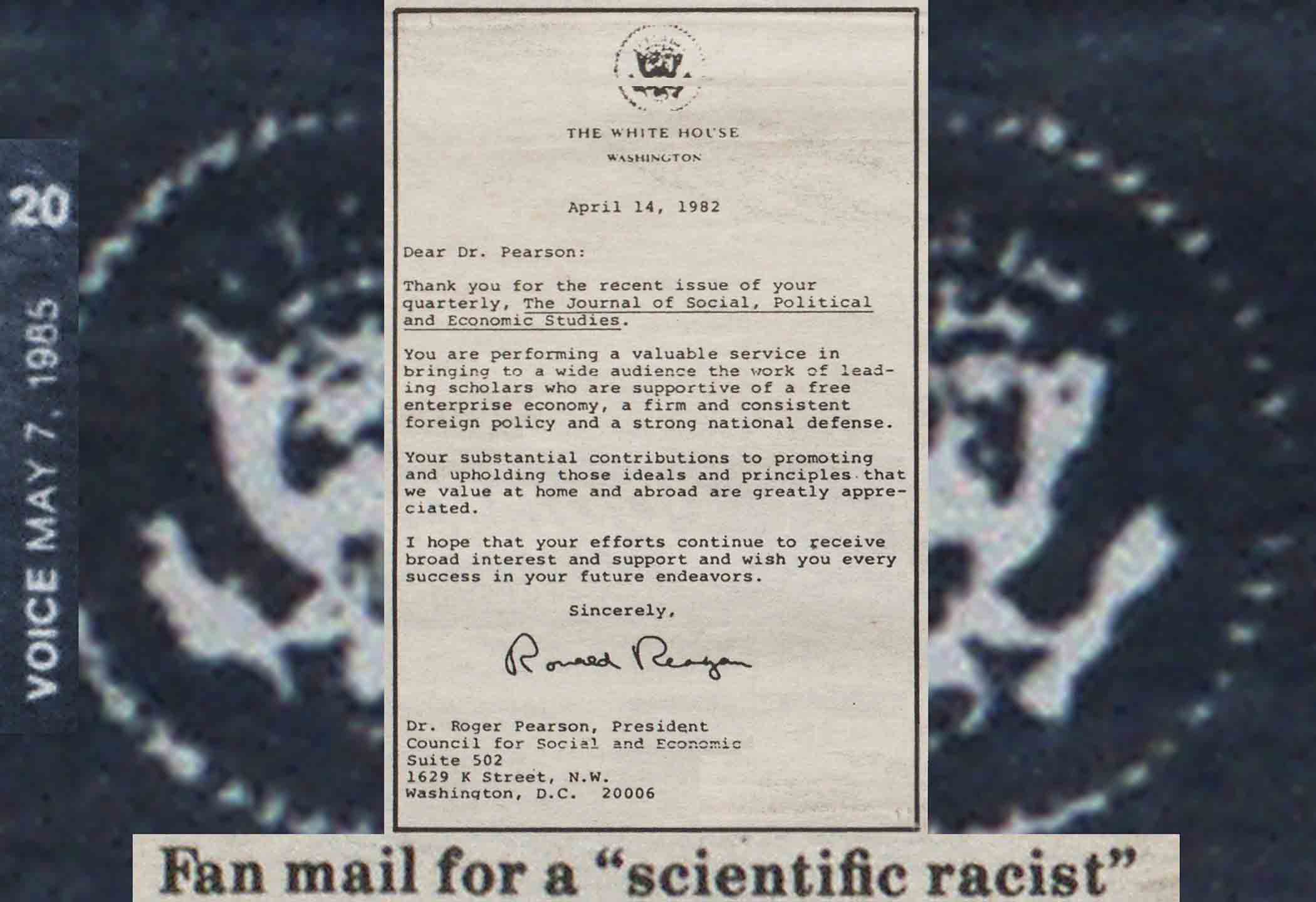
Last summer Justin Finger, the civil rights director of the Anti-Defamation League of B’nai B’rith (ADL), learned that Reagan had sent a letter of praise on White House stationery to a Dr. Roger Pearson, editor of The Mankind Quarterly and the Journal of Social and Economic Studies. Dated April 14, 1982, the letter was brief:
Thank you for the recent issue of your quarterly…
You are performing a valuable service in bringing to a wide audience the work of leading scholars who are supportive of a free enterprise economy, a firm and consistent foreign policy and a strong national defense.
Your substantial contributions to promoting and upholding those ideals and principles that we value at home and abroad are greatly appreciated.
I hope that your efforts continue to receive broad interest and support and wish you every success in your future endeavors.
The man to whom the president wrote that letter is one of the world’s leading promoters of neo-Nazi, anti-Semitic and racist ideology. Indeed, he has been a leading figure among the world’s fascists for more than 25 years, and has been expelled from several far right organizations for his extreme racism.
When the ADL’s Finger learned of the letter, which Pearson used for fundraising purposes, he lodged a protest with the White House and issued a public statement saying that it “ought to repudiate this bird.” But the incident never received much publicity beyond a brief account in the September 28 Wall Street Journal. According to the ADL, they have never gotten a response from the administration to this day. (Coming as it did just prior to the 1984 election, the reasons for the ADL’s reticence seem obvious. Unlike the matter of Jesse Jackson, an object of unrelenting criticism from the ADL, the organization’s leaders preferred not to embarrass their friend Reagan with the Pearson note.)
According to the Journal account by Rich Jaroslovsky, Pearson obtained the letter with help from Robert Schuet-tinger, an editorial board member of the Journal of Social and Economic Studies who then worked in the White House. Schuettinger, who has also worked for the Defense Department and as a senior policy analyst for the United States Information Agency, could not be located for comment last week. But in September he told Jaroslovsky that “there was absolutely no valid grounds to accuse [Pearson] of racism.” A presidential spokesman said that Reagan simply “opposes racial discrimination in any form,” but declined to comment on Pearson. Incidentally, among the contributors to the spring 1978 edition of Pearson’s journal was Helmut Kohl, then parliamentary leader of the right-wing opposition in the Bundestag.
Who Is Roger Pearson?
Researchers into the netherworld of postwar fascism have discovered that Pearson, who holds a doctorate in anthropology from the University of London, began his career as a racial propagandist in India. He had settled there as a tea planter after serving in the British Indian Army, and began publishing a magazine called Northern World in 1956. Northern World was soon being promoted in Right, a 1950s publication backed by the notorious American fascist and anti-Semite Willis Carto, who would later collaborate with Pearson in the United States. Carto’s magazine said the laudable purpose of Northern World was to “make whites aware of their forgotten racial heritage, and to cut through the Judaic fog of lies about our origin and the accomplishments of our race and our Western culture.”
By 1958, according to the British anti-fascist publication Searchlight, Pearson had set up the Northern League, whose purpose was to draw together the strands of postwar neo-Nazism. Among its first members was Hans Günther, a German prewar racial theorist whose “Nordicist” notions of Aryan superiority were honored in 1941 with the Goethe Medal of the Third Reich, bestowed by Hitler’s chief ideologue Alfred Rosenberg.
Pearson moved to the United States around 1964 or 1965, joined forces with Carto and became the editor of a successor to Northern World published by Carto’s Noontide Press based in Los Angeles. The new title was Western Destiny, and its editorial board was a rogues gallery of racists and anti-Semites: Klan leader Ernest Sevier Cox; Holocaust debunker Austin App; former Waffen-SS officer Arthur Ehrhardt; British fascist A. K. Chesterton; South African anti-Semite Ivor Benson; prewar British Nazi sympathizer Admiral Sir Barry Domvile; and various flotsam from the National States Rights Party, the White Citizens Councils, and Gerald L. K. Smith’s Christian Nationalist Party.
After stints teaching anthropology at two small colleges in the Deep South, Pearson established himself in Washington and took over the editorship of The Mankind Quarterly from its founder, a Scots aristocrat and longtime friend named Robert Gayre. Gayre, a physical anthropologist educated in Edinburgh, has a similar willingness to associate with Nazis and neo-Nazis. Mankind Quarterly featured an academic style in its expositions of “scientific racism.” Gayre’s account of a 1962 trip to South Africa, sponsored by the apartheid government, to study Bantu “racial characteristics” was illustrated by a photo of a Zulu man in profile, intended to illustrate his “Jewish nose.”
Although The Washington Post reported in May 1978 that Pearson hasn’t published any “overtly” racist material since the mid-60s, his books continue to appear on lists recommended by racist and anti-Semitic organizations such as the British National Front. A September 1984 issue of National Front News, according to Searchlight, had two Pearson volumes newly added to its booklist: Eugenics and Race and Blood Groups and Race. And in recent years he has received at least $36,000 from the Pioneer Fund, a foundation dedicated to scientific racism and run by political associates of Senator Jesse Helms.
Pearson eventually managed to ingratiate himself with more respectable rightist organizations in Washington, where he now lives. In 1977 he joined the founding editorial board of Policy Review, the quarterly published by the now-prestigious Heritage Foundation, whose associates have filled the ranks of the Reagan Administration at all levels. (He was later asked to resign when he became a potential embarrassment.) And he also acquired a high-ranking position in the World Anti-Communist League, a far-right international coalition which has been a longtime haven for neofascists and worse from Europe, Latin America and the Far East since its inception in 1967.
Indeed by 1978 Pearson had become WACL’s chairman, and hosted the group’s convention that year in his adopted hometown. Paul W. Valentine of the Post observed the convention and noted that aside from orthodox anti-Communists, the gathering attracted more than a few Nazi types. Valentine reported that among Pearson’s assistants there was “Earl Thomas, a former American Nazi party stormtrooper,” and described Pearson’s reaction to the appearance of two American Nazis peddling anti-Semitic material at the conference.
He asked them to leave, adding apologetically, “Not that I’m not sympathetic with what you’re doing … but don’t embarrass me and cut my throat.” Among the speakers at the 1978 WACL affair was spaceman Senator Jake Garn of Utah, who later denied knowing the nature of his audience.
As early as 1974 there had been warnings from WACL dissidents about the Nazi tendencies of some of its European and Latin adherents. Though Pearson might have seemed by this point to be pulling away from his Nordicist past, in fact there were many in WACL who felt he was pushing their organization further toward the fascist fringe. A faction fight broke out in 1980, which surfaced when Pearson’s opponents in WACL issued “The Blue Document,” a tract accusing the anthropologist of recruiting Scandinavian neo-Nazis to join the organization.
Pearson soon resigned from WACL, which is now headed by General John Singlaub, who denounced him to the Journal and said he was “not at all welcome in any [WACL] activity.”
Less than two years after his resignation under duress for consorting with neo-Nazis, Pearson obtained the letter from Reagan with the help of White House aide Schuettinger. Pearson has always been reluctant to talk to the non-rightist press. “I’ve only got one thing to say to you,” he told the Voice. “After some pretty bad experiences with the press, I have nothing to say. But I also wish to say that the Wall Street Journal attorneys have been notified that that article was inaccurate.” While declining to specify the inaccuracies, he added ominously, “I do hope you’ll remember you’ve been notified,” and hung up.
Nazis in Our Midst
Until this month, the loudest controversy over Nazi war criminals and the Reagan administration was prompted in 1982 by the appointment of J. Peter Grace to head a presidential panel probing alleged government waste. Several Jewish groups and congressmen protested because industrialist Grace had hired a convicted Nazi war criminal, Dr. Otto Ambros, as a scientific consultant, and had aided Ambros in gaining entry to the United States (“The Corporate State of Grace,” Voice, April 12, 1983). The contretemps remained small, and the White House stood by Grace, who went about his mission of debunking the welfare state. Few Jewish leaders spoke up, because Grace is after all a respected businessman; a dinner in his honor at Yeshiva University was canceled, however, when Holocaust survivors threatened a demonstration.
Yet the work of prosecuting Nazi war criminals who found refuge in this country — illegally, though usually with the connivance of government agencies or the intelligence network — went on under Reagan much as it had begun in 1979. It was then, during the Carter administration, that Elizabeth Holtzman and other members of Congress helped create the Justice Department’s Office of Special Investigations (OSI), which prosecutes and deports alleged Nazi war criminals and collaborators who fraudulently entered the United States.
This honorable effort, begun nearly 20 years after journalists such as Charles R. Allen Jr. revealed that scores and possibly hundreds of such criminals reside here, has long been a bipartisan effort. (The secret policy of bringing the Nazis here for scientific and intelligence pursuits had, after all, also been bipartisan.) It was perhaps the only initiative of the Carter years which the Reaganites did not immediately attempt to dismantle.
But earlier this month, the World Jewish Congress (WJC) sounded an alarm. For months the congress had monitored a campaign by East European émigré groups, many on the ultra-right, to abolish the OSI and establish a statute of limitations on Nazi war crimes. Of the dozens of cases pursued by OSI, most were directed at such émigrés, who were embraced by U.S. agencies despite their dubious activities as potential tools in the Cold War. Until recently this émigré campaign has had little impact. Senator Alfonse D’Amato, for instance, was prevailed upon last year by the Joint Baltic American National Committee to protest the pending deportation of an alleged Estonian concentration camp murderer. A few months later, he angrily withdrew a letter he had written on behalf of Karl Linnas, a Long Island resident, and charged that the committee had “duped” him.
But with the elevation of Patrick Buchanan to a top White House job, the WJC worried that the émigrés would have a friend next door to the president.
Like the émigrés, the ultraconservative Buchanan favors the abolition of the OSI, an unusual position even among American right-wingers. Buchanan first declared his enmity for the special agency on a Washington TV program aired January 7, 1982, WDVM-TV’s “After Hours,” with Buchanan as a regular panelist and Allan Ryan, then director of OSI, as a guest.
Before Ryan could even complete his opening statement, Buchanan interrupted. His question, like most that followed, was rhetorical and foolish, but its purpose was clear. “Do you think that Dwight Eisenhower … condoned the Holocaust because he didn’t set up an OSI in the ’50’s?”
Ryan, of course, said no such thing. But Buchanan whined, “Why keep a special office to investigate Nazi war criminals? … Why would you set up an entire shop in the Justice Department, with $2 million, when Eisenhower didn’t do it, Truman didn’t do it…”
The OSI director tried to explain that special skills were needed to ferret out crimes committed more than four decades ago on another continent. That only prompted more querulous demands: “Here we are, going after people 60, 70 years old, throwing ’em out of the country. But what is the purpose?… Why not abolish your office, and if people bring information about a Nazi living in this country, then prosecute ’em.”
Again Ryan tried to explain patiently. Indeed, when Buchanan complained about a case in Chicago where a Polish émigré appeared to have been falsely accused, Ryan pointed out that it had been prosecuted by Chicago’s U.S. attorney, not OSI, and that OSI’s special abilities might have prevented such an error (if error there was). OSI, in fact, decided to drop that case, which it had inherited on appeal.
None of this gave Buchanan pause. After accusing Ryan of causing an accused war criminal to commit suicide, and of “collaborating” in OSI cases with the Soviets, he delivered a verdict. He saw nothing singular about the Holocaust, he said, and “it just seems to me [that allocating funds] into running down, aggressively, these people is just not a proper use of resources.” The OSI, he declared, is a “bootless enterprise.”
Buchanan has also been a columnist for the Moonies’ daily the Washington Times. Nearly a year after his televised confrontation with Allan Ryan, he wrote a column headed “Nazi Hunting-with Guidance from the KGB.” He offered a defense for John “Ivan the Terrible” Demjanjuk, a Cleveland man facing deportation to Israel for war crimes at Nazi death camps, accusing OSI of relying on a document “that appears a patent forgery, produced for U.S. courts by the KGB.” He neglected to mention five Israeli survivors who identified Demjanjuk. And nearly a year after learning from Ryan that the Chicago case of Frank Walus was not originated by OSI, he again labeled it an OSI case. Responding to an answer published by Assistant Attorney General Stephen Trott, Buchanan responded on February 22, 1984, that the real “Ivan the Terrible” had been murdered by camp inmates. Without identifying it as such, he cited a novel by a French author as evidence.
Trott had accused Buchanan of “preconceived ideological bias” in his attacks upon OSI, and in light of Buchanan’s new job his rejoinder is worth quoting: “About Mr. Trott’s gratuitous insult that those of us questioning OSI’s connections to the KGB are, by a ‘preconceived ideological bias,’ naturally disposed toward the cause of Nazi war criminals. Surely such an attitude should disqualify its bureaucrat author from service in the administration of a president who professes a similar ‘ideological bias.'”
The former columnist and speechwriter for Richard Nixon (whose anti-Semitic slurs on the Watergate tapes echo in his endorsement of the Bitburg trip) is said to have great influence on the president whose image he now shapes. It is even said that he, more than any other White House staffer, has convinced the president that the trip to Bitburg must not be canceled.
❖ ❖ ❖


