







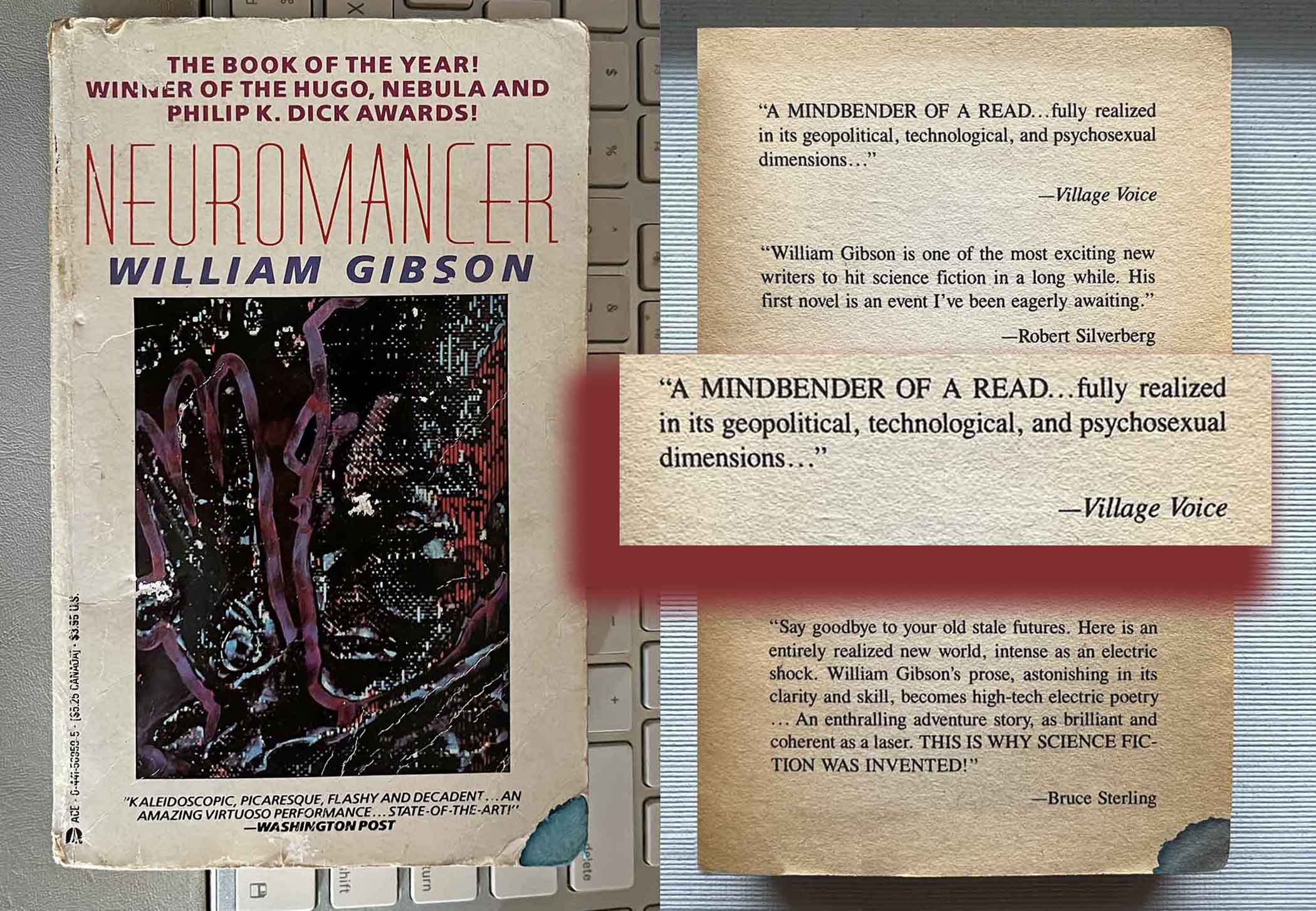
Editor’s note, August 4, 2026: Recently, we were struck by a tableau in Penn Station that reminded us of an unnerving scene in William Gibson’s 1984 novel, Neuromancer. Using our own battered and stained paperback to research the piece, we came across this blurb, near the front of the book:
A MINDBENDER OF A READ … fully realized in its geopolitical, technological, and psychosexual dimensions…
—Village Voice
We immediately poked around online to see whether, in other editions, the blurb included a byline, since we are always interested in finding another prime example of the paper’s often prescient criticism, and it would help us find the full review in the archives more quickly. We had no luck, though we did see the quote occasionally landing on the covers of various reprints, sometimes shortened to “A mindbender of a read. —Village Voice“
Since Neuromancer was originally published on July 1, 1984, we began plodding through the June issues of the Voice, getting no hits until the July 3 issue, which featured a summer beach reads section in which Geoffrey O’Brien tackled a long list of “Whodunits” while Debra Rae Cohen wrapped up a roundup of recent sci-fi novels and anthologies. She had luminous praise for Gibson’s debut, though not the line we were looking for. But for those who love to while away their time in the Strand’s aisles, Cohen’s labor-intensive multi-review blast from the past offers plenty of other keepers from a particularly fertile period for the genre, the mid-’80s, which also gave us such novels as Margaret Atwood’s The Handmaid’s Tale, Orson Scott Card’s Ender’s Game, and Carl Sagan’s Contact (all from 1985), along with Blade Runner and E.T.: The Extra-Terrestrial (both 1982) and The Terminator (1984) thrilling huge audiences in theaters.
We will continue to seek out the Voice review that has, over the decades, been a bonanza for PR reps and book designers alike, but in the meantime, here is Cohen’s insightful hot take on a tome for the ages. —RCB
→ This article from the archives is part of an ongoing series celebrating the Voice’s Platinum Anniversary — 70 years! The first issue appeared on the streets of NYC on October 26, 1955. ←
Beach Blanket Genrefication
2. Sci Fi
By Debra Rae Cohen
Originally published:
Most readers of genre fiction can turn from virgin to veteran simply by plowing through the interchangeable works of one or two authors. Mystery readers can work their way from Christie to Sayers to Tey without fear of hitting unfamiliar turf; romance fans need only select the imprint that serves up their favored formula. But where other genres are defined by their restrictions, science fiction is a Klein bottle — the whole world is its “inside.” The more readers stick to working their way through series, sagas, and trilogies, checklisting their way through well-known names, the more they limit themselves to the mundane and mediocre.
The lifeblood of sf has always been in short stories; nurtured by the pulps, big-name writers like Robert Silverberg, Jack Vance, and Frederik Pohl continue to write short fiction even in today’s novel-dominated market. Until recently, a vital network of original anthologies supplemented and supported the always uneven sf magazines, introducing new writers and serving as road maps for the new reader. But the same rich-get-richer publishing climate that established “safe” series as the norm has also, in the past few years, led to the demise of long-running anthologies like New Dimensions, Destinies, Chrysalis, and Orbit. Back issues of these, and of Terry Carr‘s Universe series, are often available in cutouts. More than certain putative “best of” anthologies — or even the Nebula award compilations — these collections add up to a systematic intro course with a consistent editorial tone, acquainting the reader with virtually every important sf writer of the last 20 years.
In particular, the five most recent Universe collections (Vols. 10-12, Zebra, $2.50 to $2.95 paper; Vols. 13 and 14, Doubleday, $11.95) have marked the rise of a strong new sf generation, many of whom emerged from well-known writing workshops: Pat Murphy, whose “Art in the War Zone” (Universe 14) is a poignant edifice of culture shock assembled from flamboyant visual images; deadpan, quick-draw Howard Waldrop, connoisseur of fictional crazy quilts, who won a Nebula for Universe 10‘s “The Ugly Chickens” (or, git along, li’l dodo); Luei-us Shepard, whose “Black Coral” (Universe 14), like his stunning first novel, Green Eyes (Ace, $2.95 paper), is half other-world dream-time, half Bayou gothic, meshing the power of fantasy with fantasies of power. Green Eyes is one of the revived Ace Specials line — an imprint that, from 1968 to 1971, under Terry Carr’s editorship, was responsible for issuing some of sf’s most offbeat classics, including Ursula K. LeGuin‘s The Left Hand of Darkness ($2.95 paper). Carr’s new Ace Specials will showcase many of the new generation’s first novels — including, later this year, Them Bones, Waldrop’s solo debut.

A concise introduction to the new writers is The Year’s Best Science Fiction ($17.95, $9.95 paper), first in a series to be issued annually by Bluejay Books, a new quality sf trade line distributed by St. Martin’s. TYB is (as its cover trumpets) twice as long as even high-level best-ofs like the Timescape series edited by the ubiquitous Terry Carr; more important, TYB‘s editor, Gardner R. Dozois, is the most imaginative anthologist in sf today-painstaking, unsentimental, gimlet-eyed, acerbic, yet adventurous and open-minded. His annual summation, which begins the volume, is a cogent précis of what’s happening and what’s moribund in sf publishing — complete and name-naming. Dozois, himself an excellent writer (winner of one of this year’s Nebula awards for his short story “The Peacemaker”), has picked a 1983 story by virtually every young writer on the rise. Kim Stanley Robinson, author of the initial New Ace Special, The Wild Shore ($2.95 paper), a low-keyed, deceptively simple tale of an adolescent boy in a balkanized California after the next war, contributes one of his quietly haunting tales. “Black Air” is only incidentally an alternate-world story of the Spanish Armada; its true subject is a young boy’s vision, awakened in impressionistic waves of language that verge on synesthesia. Connie Willis, last year’s Nebula winner for her affecting time-travel novelette “Fire Watch” (available in Best SF of the Year 12, Timescape, $3.95, and in Willis’s forthcoming Bluejay collection), is represented in TYB by “The Sidon in the Mirror,” a subtle and chilling tale about self-knowledge and self-control. Dozois also offers stories by up-and-comers Pat Cadigan, John Kessel, and Waldrop’s fellow Texan Leigh Kennedy, as well as “Slow Birds,” a deft, downbeat story by the brilliant British writer Ian Watson, two Nebula-winning stories by the established young writer Greg Bear, and excellent work by better-known names such as Robert Silverberg, Poul C. Anderson, James Tiptree Jr., and the dervish-brained R. A. Lafferty.
Regrettably, TYB misses out on my favorite of the new crop of writers. I first ran across William Gibson through his fever-bright stories “Johnny Mnemonic” and “Burning Chrome” in Omni magazine, and have since burrowed through old Universes, Omni best-ofs, and lesser-known periodicals, unwilling to miss a single published word. Gibson’s stories plunge you into a coherent universe, a world of the not-too-far future that’s urgent and hyperventilation-close — like the visuals in Blade Runner — through its sheer mass of vivid detail. Like Texan Bruce Sterling (whose “Cicada Queen” is one of the strongest pieces in TYB), Gibson delineates a world split by attitudes toward pervasive technology. Like K. W. Jeter — whose Dr. Adder (Bluejay, $7.95 paper) has the brain-burned intensity of his mentor Philip K. Dick — he sketches a new urban underworld, black-marketing microchips and body modifications, laser weaponry and bootleg pharmaceuticals refined by control of the body’s own drugs. But where Sterling’s intricate “Shaper/Mechanist” stories depend on external tension and street-level philosophical debate, Gibson’s high-tech, high-tension work crawls in the cracks of a “well-regulated” world. Where Jeter’s jousts between computer-augmented evangelism and black-market braggadocio are limited by their L.A. insularity, Gibson offers a world internationalized by money and information; interlocking data nets serve as ceiling to the underworld, jungle gym for computer cowboys in search of a line in and a leg up. Most sf writers spell out a world and then color it in; Gibson shows us corporate monoliths and looming power from below, through a roiling mixture of black leather and chrome, personal weapons surgically installed, cybernetically boosted cosmetic changes, Yakuza enforcers and coffin-stacked flophouses. His world is gradually assembled from the multiple-angled snapshots of his stories, each crisply focused and individual as survival. Gibson’s first novel, Neuromancer (Ace, $2.95 paper), like all his work, is unforgettable. Through his characters’ squints at the main chance — the scams and hustles, big and small, of a thousand scrabbling one-shots — Gibson distills a technopunk sensibility with the kick of white lightning and the clarity of white light.
❖ ❖ ❖


